Showing posts with label my story. Show all posts

Tuesday, March 6, 2012

It’s Hard to be a Pastor

In a post called Why I Won’t Call Myself a Preacher, former church of Christ pastor Dan Bouchelle talks about the difference in being an occasional speaker at a variety of churches and the hard work of being the vocational pastor at one church.
He said:
  • It is easy to deliver a few engaging sermons for many churches around the country. It is hard to preach engagingly and meaningfully to the same people every week for years.
  • It is easy to fly in and sound like an expert for 30 minutes and fly out. It is hard to love people through their every-day journeys all week long for years.
  • It is easy to give advice between plane rides and wash your hands. It is hard to actually lead a church through a massive transition in vision and character.
  • It is easy to talk about discipleship to people who never see you outside of a church building. It is hard to be a disciple who makes disciples with people who see you at the grocery store, ballgames, and watch you drive on their streets.
I know where Dan is coming from.

I have to keep putting off my own “pastor” label.

I serve as a missionary. Even so, my family and I have a church home in Brazil, Igreja Batista da Vitória. I am not the pastor, nor am I considered staff at the church.  I am called pastor much more than I am called by my own name. I do shepherd, but I serve mostly outside the church. I keep telling people, just call me “Estive.” (It sounds like Steve and is easier for Portuguese speakers to say. )

I am, however, the de-facto pulpit supply when the pastor is away. This means I get to preach a small series of three to four sermons every once in a while. My church always enjoys it and frequently asks me to preach more often. I am cautious about this. I always make it a point to affirm the pastor and direct the church toward his vision and leadership. I always share with the church how good it is to have him as my pastor.

It is very easy to make a pastor look bad or feel bad by dazzling a group with a good message or dynamic workshop. That just isn’t profitable for anyone. (Except the person with bad motives.)

Pastors need to be encouraged.

I remember once when I was serving in a large multi-staff church, the senior pastor had just resigned. Though there were still seven of us associate pastors on staff, the church thought it a wise idea to bring in guest preachers for the first several weeks. This would fill the pulpit until the next business meeting, when the church would call one of our associates pastors to serve as the interim pastor.

One of the supply preachers was a friendly man with a knack for telling a good story. He preached a simple and entertaining message with applications from the story of David and Goliath.  In the following weeks there was a bit of “talk” among a few of the church members that we should consider this guy to be our next pastor.

The church personnel committee and future pastor search committee saw beyond this, of course, and the church eventually called one of our associates as senior pastor. What I remember from this episode, though, was how the heaping praises for a guest preacher caused some on our staff to feel undervalued.

A common challenge.

This probably happens more than you think. Pastors do not perform well when they are discouraged. (Neither did the old testament prophets.) On the other hand, when they are appreciated, they tend to go the extra mile and a half. You can make a difference in what kind of pastor you have by the way you treat him.

This post is not the usual evangelism oriented material. It is just a reminder to encourage your pastor regularly. Pray for him. Pray with him. And, if you are brave enough and wise enough, become his friend. (I say wise enough, because some people foolishly think that the pastor is, or should be, on another level and separate from the rest. If you treat your pastor that way, both of you will suffer for it.)

Tuesday, August 2, 2011

About Me in 2011

These blogs are a hobby of mine. I have a history of updating them in spurts, and taking long unannounced breaks when other projects come up. There are a number of posts on the backburner right now, but I just haven’t had the time to write them out.

This year, 2011, started with a number of challenges for us. We returned from our Christmas visit to the US, only to find that we had to make some quick adjustments.

We found out that we had to move from our apartment and in short order. We prepared and moved into a house in a nearby neighborhood. Our son’s afternoon preschool closed down, so we enrolled him in a new preschool near our new place. We had to make a significant change in our budget and so we reduced it by a third and I started working teaching English again.

Though we have been planning to move to the US for a while now, our church search process has taken longer than we expected. We’ve come close, but God guided us in others directions. Following His lead, we have set a definitive date to move to the US even if that means moving without a church position. We are still watching for God’s assignment there.

In the meantime, there is much to do here. Loaise continues to run and manage her company, and plan for our transition. I am preparing to travel to a few different places in Brazil and lead training workshops this year. I am helping a local church to learn the ropes of starting daughter churches in nearby neighborhoods, and assisting its pastor and deacons in better organizing the church’s committee structure. I continue to teach Bible storying and oral discipleship methods in this city.

Those of you who know me, know of my challenges with hearing. I was born with hearing impairment and have used a hearing aid for 30 years. Even so, I have been able to learn other languages and work effectively in ministry and missions. Most of the time I don’t remember I am hearing impaired.

This year, I learned that I could receive a cochlear implant and hearing rehab through the Brazilian One Health System. I had never considered this surgery in the past, as it was both extremely expensive and indicated only for my hearing ear. This would mean destroying the hearing I already had.

Technology has advanced. I can now receive an implant for my deaf ear instead. By using both my health insurance and the One Health System, I can have this surgery without charge, and in my own city! This could significantly improve my hearing range and comprehension, and there is no risk to my hearing as it is now. What a blessing!

We continue to work hard in mission and ministry in Jesus name. There are many who need to hear, and many who need to follow. We are working steadily on transition as well. I also have a number of online projects that I will be revealing in the coming months. We continue to talk with churches in Louisiana, mostly in the Baton Rouge area, and believe that God has been preparing a church for us, as he also prepares us.

Where ever you live, continue to serve God, doing the hard work of evangelism and disciple making to the glory of Jesus. We are coworkers in his Kingdom.

Keep watching this blog and my others as I will be bringing new blog articles and updates.

http://stephenmyoung2.blogspot.com

http://smy2brazil.blogspot.com

http://beyondoutreach.blogspot.com

Wednesday, October 13, 2010

Group Dynamics of the 12 Disciples

I earned my undergraduate degree from East Texas Baptist University. My major was Religion and my minor was Psychology. The minor, I owe to Dr Lynn New. He was so captivating in his required  course “Introduction to Psychology,” that I kept taking his classes until I had enough credits for a minor.

I did not know it at the time, but his class “Group Dynamics” would be the one to help me most in my future ministry. As I began to pay attention to how groups form and function, I saw many parallels in the church. I marveled at how some people had a knack for attracting people and getting them into groups. While I understood the theory, I was not very good at it. I thought it was a mark of a good minister, to be able to organize people and create groups where people could grow in the Lord.

For me, the Biblical example was Jesus, who seemed to be able to just walk by people and draw them in.
Passing alongside the Sea of Galilee, he saw Simon and Andrew the brother of Simon casting a net into the sea, for they were fishermen. And Jesus said to them, "Follow me, and I will make you become fishers of men." And immediately they left their nets and followed him. And going on a little farther, he saw James the son of Zebedee and John his brother, who were in their boat mending the nets. And immediately he called them, and they left their father Zebedee in the boat with the hired servants and followed him.    (Mark 1:16-20)

He went out again beside the sea, and all the crowd was coming to him, and he was teaching them. And as he passed by, he saw Levi the son of Alphaeus sitting at the tax booth, and he said to him, "Follow me." And he rose and followed him.  (Mark 2:13-14)
I had not yet begun paying attention to how Jesus trained his disciples to disciple families and groups, nor had I studied the formation of churches in the book of Acts. If I had done that, I would have seen that the apostles primarily relied on others to form the groups.

The case of Jesus calling his group of disciples, however, is not as random as it it appears in Mark. There is a big back story. Here is my telling of it:


The Calling of the Twelve

Before Jesus began announcing the Kingdom of God, his blood-relative John the Baptist was preaching repentance and telling everyone that a special person was coming. When Jesus came to the Jordan river to be baptized, John pointed him out. “Look, the Lamb of God, who takes away the sin of the world!”

Two of John’s disciples followed after Jesus when they heard that, and they spent a day with him getting to know him. One of those two disciples was Andrew, Simon Peter’s brother. Andrew then told Simon that he thought Jesus might be the Messiah.

The next day, Jesus went to Galilee and spoke to another man named Philip, who was from Andrew’s hometown Bethsaida. Philip went and talked to his friend Nathaniel just as Andrew had gone to Simon. “We have found the one Moses talked about. Come and see!” The following day, Jesus went with them to a wedding in Nathaniel’s hometown Cana. That is where he performed his first miracle, but only a few people saw it.

Jesus then went to Capernaum for a few days to visit family, and then on to Jerusalem for the Passover. When he went to the temple, he took issue with the money changers and chased them out. He also taught and performed a few miracles. Many people in Jerusalem started to believe in him, but he knew their hearts and didn’t trust them. However, there was one Pharisee named Nicodemus who met with Jesus and was convinced. From then on he supported Jesus among the Pharisees.

Now, After this, Jesus went out again to the Jordan area in Judea where John the Baptist was still baptizing people. Only now, some of his disciples were starting to follow after Jesus and Jesus began to draw bigger crowds than John the Baptist. John approved of this, but in order to avoid problems Jesus left with some of his followers and went to Galilee.

On the way he passed through Samaria and met the woman at Jacob’s well. He ended up spending three days in the village of Sychar where many Samaritans trusted in him. Then when Jesus finally arrived in Galilee, he was well received, and he also went back to Cana, and again to Capernaum. It was around this time that John the Baptist was arrested and imprisoned.

Jesus went out to the seashore and taught the people there. For crowd-control purposes, he sat in Simon’s boat. When he finished teaching, he asked Simon to push out and drop the net in deep water. Andrew and Simon pulled up so many fish that they had to call their partners over to help. So, Jesus’s cousins, the Zebedee brothers, James and John came over to help pull in the fish. Peter realized, then, that following Jesus would be even greater, and more dangerous calling than following John the Baptist. That is when Jesus called them to be His disciples and fishers of men.

There near the shore was Mathew, almost certainly a close acquaintance, if not friend of the fishermen. Jesus called him to follow as well.  That very night, Matthew called a bunch of his friends together and threw a dinner party. He invited Jesus as the guest of honor. This happened quite a lot with Jesus in all the neighboring towns.

By this time, Jesus had quite a large number of followers. He went up the mountain to pray, spending the whole night there. Then, in the morning, he called all of his disciples together and chose from among them, twelve to be his apostles. These twelve would be close to him, and be sent out to represent him, preaching the gospel, and casting out demons.

He chose:
Simon, to whom he gave the name Peter
Andrew, Simon’s brother
James, the son of Zebedee and Salome, who was Mary’s sister
John, James’ brother, and also cousin of Jesus
Philip, John’s disciple
Nathaniel, also called Bartholomew, Philip’s friend
Matthew, the son of Alphaeus, also called Levi
James, the son of Alphaeus (possibly Matthew’s brother, but we don’t know)
Thaddeus, whose name was also Judas
Simon, the Zealot, and
Judas Iscariot, who betrayed him.

Wednesday, October 6, 2010

Lessons from a Missionary

On my other blog, http://smy2brazil.blogspot.com, I  began posting a series on the lessons I have learned from experience. Some of these things cross over to the American context well. Have a look.


Lessons Learned: How to be a Missionary

Wednesday, September 22, 2010

How to Pray for Other Christians

When I began using a prayer calendar, I quickly realized that if I didn’t have specific prayer requests next to the name of a person for whom I was praying, I didn’t have much to pray about. My prayers were generic “Bless this person and his family. Meet their needs. Protect them.” etc.


In order to develop a vocabulary of prayer for other Christians, I began to survey the things that Paul prayed for as he prayed for Christians in another place.  I made some observations from the letters to the Ephesians, Philippians, Colossians and Thessalonians


Now, Imagine I were praying for you. This is how I would do it following Paul’s example.
As I pray, I would:

  • thank God for you.
  • ask the Father to give that you wisdom.
  • ask the Father to reveal himself to you, so that you know Him more
  • ask that your eyes be enlightened to see all God offers his holy ones, the hope, the rich inheritance, and his mighty power.
  • ask that you will really understand how God's same mighty power that resurrected Jesus works in your own life.

Ephesians 1:15-20


  • thank God for you
  • ask that your love grow, both in knowledge and discernment so that you can see what really matters and be pure.
  • ask God for your righteousness to reproduce in others.
  • trust God to supply all your needs according to His wealth and glory in Christ Jesus.

Philippians 


  • ask that you will know God's will, have wisdom, and spiritual discernment.
  • ask for God to help you live your life in a way that honors and pleases the Lord.
  • pray for you to do good and produce fruit.
  • pray for you come to know God better.
  • ask for God to strengthen you with his power.
  • pray for you to be patient and have the endurance you need.
  • Pray for you be filled with joy, and that you would be thankful to God  because he has rescued us through his son Jesus.

Colossians 1


  • thank God for you and remember before Him the things you have shown in your faith
  • recount your works of faith.
  • remember your works of love.
  • recall the ways your hope in Jesus has given you preserverance.
  • thank God that when you heard the word of God, you believed, and remember what it cost you.
  • remember your faith and faithfulness in your persecution for encouragement in my own.
  • thank God for the joy I have because of you
  • ask the Lord to open the way for us to meet again
  • ask that God would strengthen your heart so that you will be blameless and holiness before the Father when Jesus returns.
  • ask that God himself would preserve you as holy in your thoughts, in your body and in your soul.
  • thank God that he is faithful to do it.

1 Thessalonians


This is a good exercise and a great way to pray for new Christians and for those you have led to the Lord or are discipling. I encourage you to take note, as you read the Bible, especially in the New Testament letters, what kinds of supplications are recorded. They are great examples of prayer.   If you have found other good examples, please post them in the comments section.

Wednesday, September 15, 2010

Giving away E-Bibles

Giving away Bibles has been a ministry hobby of mine for a long time. I have a tendency to give my own Bible away too often. There was a period of time when I couldn’t keep a Bible in my possession for more than a month. I just always found reasons to give it away. I still do. It usually goes like this:

“Did you ever hear the story of ____?”

“No?”

I begin telling the story. (I also have a blog about Bible storying).

As I tell, I open my Bible to that passage. When I finish the story, I show the person where it is in scripture.

I ask “Do you have a Bible that’s just for you?” If they say no, I give them mine.

“This is mine, but I want you to have it. I have another Bible at home that I can use.

If the person politely refuses, I just tell them to consider it a gift. I don’t insist. Nine times out of ten, they take the Bible.


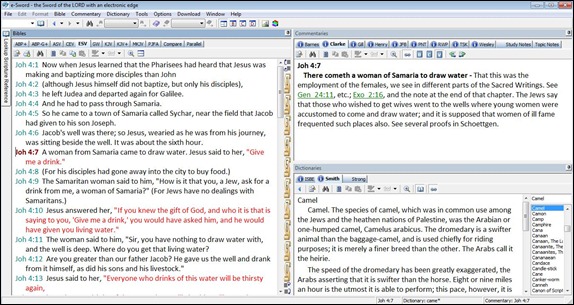
Last week I discovered a really great, free program called E-Sword, which you can download for yourself by clicking the screenshot below.


It comes with the King James Version, but you can also download dozens of other translations for free. There is also the option to pay for some translations that are not available freely. You can also download free Bible study dictionaries and encyclopedias and a number of commentaries. Many are free, and some you must purchase. There is even a space in the program for you to write your own notes on certain passages, which you can access just like the commentaries and dictionaries.


These days nearly everyone is online and uses a computer regularly. Having a Bible on the computer can be extremely helpful. This is just one more way to give the Bible away.


 E-Sword

E-Sword.net –> http://www.e-sword.net

Optional Bible Translation add-ons –> http://www.e-sword.net/bibles.html

Friday, July 2, 2010

Now What? Part Two

In my post Ok, they said “Yes.” Now what?, I proposed that the best discipleship process for new believers or near-believers is a family bible study in that person’s home with his close friends. Since this topic is being explored in other blogs (The Assembling of the Church and learning… ), I wanted to keep talking about this.


First off, let me give an example. There is a family we led to the Lord some time back. I wrote about them in my Bible Storying Blog in two posts “Rain, and showers of blessings” and “Who will deliver me from this body of death.” Please click on those links and read their story first.


Last night they came to our prayer meeting in the traditional church. Husband, wife, three children and their dog. Long story short, the dog fit in better than the family. Our church was very gracious with them, but it is obvious they just don’t fit. They try, but they can’t. Too many issues.


What will end up happening is that after a few weeks, they will be made to feel more and more unwelcome until they don’t come back. They have been church hopping since they’ve been saved, spending a month or two in each place before they give up and look for another. It is sad, and it is a story that repeats itself innumerous times in countless places. Life changing discipleship and spiritual reproduction never happen in those situations.


The harder, but more effective way to bring people up to being real followers of Jesus whose lives are transformed and who produce thirty, sixty and one-hundred fold increases is discipling people in their own households and with their own friends. This is especially true when the person being discipled does not naturally fit into the culture of your church.


“Now What? Part Three” is going to explore why, and “Now What? Part Four” will explore how.

Wednesday, March 24, 2010

Little Things

In our traditional church here in Brazil we have been having a little flood of baptisms. Ten here, three there, then six more. What is counter intuitive is that none of these baptisms are a result of any evangelistic push or visitation program. They are not the results of church programmed home bible studies nor any of our community ministries. They are just the cumulative result of members telling others about Jesus.


Our ministry forums (the preaching services, children’s church, crafts ministry, etc) are not where the real ministry happens in most cases. They are points of connection that make sharing Jesus possible.


One example is of a lady who came to our church during a Wednesday afternoon to ask for a basic basket (that is a box of rice, beans, flour, sugar, oil, pasta and salt) from the benevolence ministry. She came while the crafts ministry was meeting. During that time, she neither got involved in the crafts, or got a hold of a basic basket, because no one from the benevolence committee was there.

What she did get though, changed her life. She began talking to one of the women, who put her project down and paid attention to the newcomer. She learned her name and found out where she lived. She asked if she could pray for her during the week and what this lady needed. The week passed and she came back again the next week singing a different song. “I don’t need a basket, I need Jesus,” she said. “No one ever prayed for me like that before.” A friendship was born, and because Jesus belongs to one, he was shared with the other.


This ought to happen much more often.


So, if your church has an AWANA ministry or angel food ministry or any other kind of “outreach,” remember that the ministry forum is not the real ministry, it is just an opportunity for real ministry to happen. The real ministry happens through people, not projects.

Wednesday, September 16, 2009

What are we really trying to do? (Part 1)

And the church is his body; it is filled by Christ who fills everything everywhere with his presence. Ephesians 1:23

The first church I ever pastored was a small country church in a small, small town. I was a youth minister and college student at a Baptist university when they asked me to preach in view of a call. The church only had a handful of members and could only pay gas expenses for me to get there and back on Sundays. The building was nice and new, not very big, but more than adequate. They needed someone to preach and I needed somewhere to get preaching experience. It was a good fit.


We would meet on Sunday mornings at ten o’clock, all nine of us. We always divided into two groups for Sunday School, then we came together for the worship service. We would sing three or so hymns and pass an offering plate. Sometimes, one of the two young girls would provide the special music. Then, of course, I would stand in the pulpit and preach to the eight. We would sometimes sing a hymn of invitation and then the service would be over. That would be it until next Sunday.


Once we as a church had found a rhythm and a good flow to our services, we began to grow. Well, not really, but we did double and triple our worship attendance. I can tell you it wasn’t growth because there was a small layer of accumulated dry dust in the bottom of the baptistery. It had not been used in years. However, as inactive members began returning to our services, the sanctuary began to fill up with enough people to warm the building. The extra envelopes in the offering plate meant that the burden of paying the bills was being eased.

We never did baptize anyone during my few years there. Though it bothered us, it didn’t sting too much. Now, that is a terribly unfortunate statement, but there is some truth it. We had the illusion of progress. Things were changing and improving. In all of that we had accomplished something that made us feel . . . comfortable. We succeeded in what we were really trying to do.


Truth be told, I was always just a visitor there in that little town. The church had been there long before I arrived and planned to be there long after I had gone. It was, and wanted to be, a perfect picturesque fit to small town religion. These people love God, but it was culture that defined the church, and it was culture that set its priorities.


The unspoken non-negotiables of the church mandated that there be a building with a steeple and that its worship service be held on Sunday mornings. The service was to last an hour and included comunal singing and a lecture. The church had to be registered as an organization with several national and state entities and have regular business meetings.


With these cultural prerequisites, our outreach was reduced to seeking people who were willing to come and be a part of what we were already doing, on our schedule, in our way, on our property. This was not Kingdom building, it was organization building. What mattered most was building and maintaining the organization. This is what we were trying to do, and that is all we ever did.


This is why every church must continually ask the question, “What are we really trying to do?” It probably isn’t what we think. No wonder so many churches are stagnant and dying.

Thursday, August 27, 2009

Beyond Outreach

I am a 33 year old missionary and have been in Brazil for nearly 8 years. Prior to this I served in a large metropolitan church and in a small country church. My family and I are now preparing to move back to the US, near the Baton Rouge area, waiting as the Lord leads and provides an opportunity for us there.


Without losing sight of the church planting work we’re doing here (see my Chronological Bible Storying Journal), I wanted to begin this blog as a way to “think out loud” about how to sucessfully obey the command of Jesus to make disciples.


In American culture, Christianity is declining. This blog will focus specifically on what the typical American evangelical church can start doing or stop doing in order to make a greater impact for the Kingdom of God.


There are already many bloggers out there writing about the state of the church in America today, about evangelism and outreach, and about making disciples. I will likely refer often to other people’s writings and will include hyperlinks so you can read them for yourselves.


Here’s a thought:

If you’re going to reach people that others don’t,
you will have to do things that others won’t.

Related Posts Plugin for WordPress, Blogger...